
Why "muscle groups" is the wrong question
Classic training planning thinks in muscles: chest on Monday, back on Tuesday, legs on Wednesday. That comes from bodybuilding, where it's about looks, and it works there too. For everyone else — people who want to be healthy, strong, and mobile — a different model has taken hold in training science since the 2000s: you don't plan by muscle, you plan by movement pattern. The body doesn't know a "chest exercise." It knows pushing, pulling, bending, extending, holding, and locomotion — and each of these patterns works many muscles at once, exactly the way they work together in everyday life.
This approach has a huge practical advantage: it's complete. Anyone who trains every pattern every week has no gap in their program — no neglected backside, no forgotten legs, no core that's only worked "along the way." And it can be done entirely without equipment, which makes it appealing to anyone training at home, on the road, or in the park.
The six patterns at a glance
1. Push
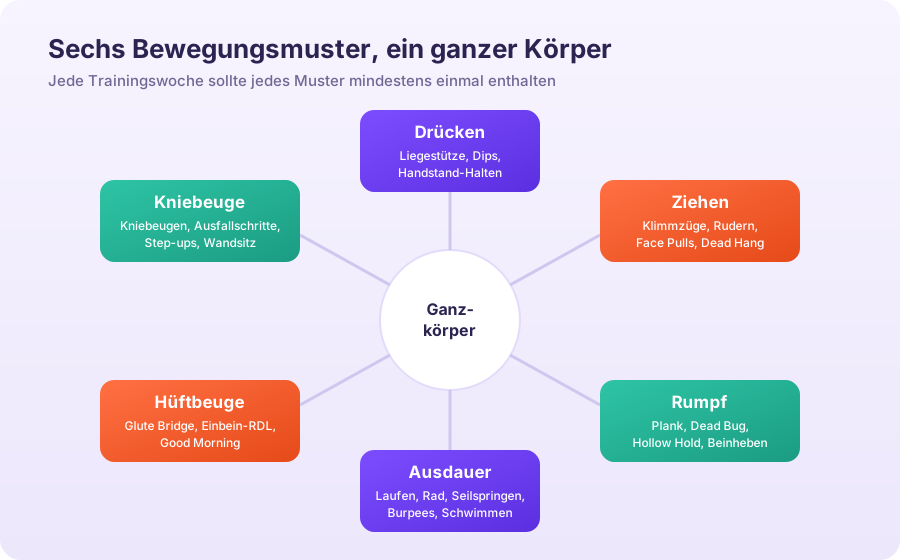
Everything where you move a load away from your body: horizontal (push-ups, bench press) or vertical (shoulder press, pike push-ups, handstand). Trains the chest, front shoulder, triceps — and, in the plank position, the entire core. Pushup Tracker takes its name from this pattern; which muscles exactly are working is covered in the article Which Muscles Do Push-Ups Train?
2. Pull
The counterpart: load toward the body. Vertically, that's pull-ups and dead hangs; horizontally, rows and face pulls. Pulling trains the lats, rhomboids, rear shoulder, biceps, and grip strength — the muscles that push-only programs neglect and that are responsible for upright posture and healthy shoulders. The single most important rule of the whole model: one pull set for every push set.
3. Squat
Knee- and hip-dominant bending with an upright torso: squats, lunges, step-ups, wall sits, jump squats. They build the thighs and glutes and are the movement that decides independence in old age: getting up from a chair, climbing stairs, picking something up off the floor. More on technique in the article How to Squat With Proper Form.
4. Hinge
The most commonly forgotten movement: bending and extending from the hip with nearly straight knees. Glute bridges, single-leg deadlifts, and good mornings train the entire backside — glutes, hamstrings, spinal erectors. Anyone who only squats develops a strong front side and a weak backside; the hinge pattern closes that gap and protects the lower back.
5. Core
Not sit-ups, but stability: plank, dead bug, hollow hold, leg raises. The core's job in training is above all to secure the spine against movement while the arms and legs do the work. Why that's the case is explained in the article Core Training Done Right.
6. Endurance
The cardiovascular system isn't a muscle, but it follows the same rules: it adapts to what you demand of it. Walking, running, cycling, jump rope, burpees, swimming. Which intensity is for what is covered in the article HIIT or Zone 2?
Why completeness matters more than perfection
The large population health studies make one point clearly: it's not the best exercise that counts, but the combination. The WHO movement guidelines (2020) recommend that adults get 150–300 minutes of moderate endurance activity per week plus strengthening exercises for all major muscle groups on at least two days. Anyone who does only one of the two gives up a large part of the effect: a meta-analysis by Momma et al. (2022) found that 30–60 minutes of strength training per week was associated with a 10–17% lower mortality risk — and that the combination of strength and endurance training lowered the risk more than either alone.
The six-pattern model is the simplest way to guarantee that combination. It forces you to take your backside, legs, and heart just as seriously as the exercise you enjoy the most.
The balanced week
Three sessions per week are enough to cover each pattern twice. The example below needs a pull-up bar or a sturdy table for rows — nothing else.
| Day | Push | Pull | Squat / Hinge | Core | Endurance |
|---|---|---|---|---|---|
| Monday | Push-ups 3 × 8–15 | Rows 3 × 8–12 | Squats 3 × 12–20 | Plank 3 × 30–60 s | – |
| Wednesday | – | – | – | – | 30–45 min Zone 2 (running, cycling, brisk walking) |
| Thursday | Pike push-ups 3 × 6–10 | Pull-ups or negatives 3 × 3–8 | Lunges 3 × 10 per side | Dead bug 3 × 8 per side | – |
| Saturday | Dips or diamond push-ups 3 × 8–12 | Rows 3 × 10–15 | Glute bridge 3 × 15, single-leg RDL 3 × 8 per side | Hollow hold 3 × 20–40 s | Finisher: 10 min intervals (burpees, jump rope) |
Each strength session takes 35–45 minutes. The rep ranges are chosen so each set ends with one to three reps in reserve — hard enough to drive adaptation, not so hard that form suffers. How to progressively increase within this framework is explained in the article Building Muscle With Push-Ups; the principle applies to every pattern.
The most common imbalances — and how to spot them
- Lots of pushing, little pulling. The classic problem of push-up enthusiasts. Symptoms: rounded-forward shoulders, neck tension, eventually shoulder pain during pushing. Test: count your push and pull sets from last week. More than 3:2 in favor of pushing is a warning sign.
- Only squatting, no hinging. Symptoms: strong front thighs, but back pain when lifting and glutes that barely engage when standing up. Test: can you hold a 30-second glute bridge without your hamstrings cramping?
- Strength without endurance. Symptoms: strong in a set, out of breath after two flights of stairs. Test: can you walk briskly or jog easily for 30 minutes while speaking in full sentences?
- Endurance without strength. The runner's pattern. Symptoms: a good heart, but fewer than 10 clean push-ups and knee trouble running downhill. Strength for legs and core is the best injury prevention for endurance athletes.
How to put the model into practice
- Log every session — exercise, sets, and reps. The analysis tab shows you how your volume is distributed by category. A week without a pull session stands out immediately.
- Plan by pattern, not by exercise. "Monday: push + pull + squat + core" is a plan you can execute even in a hotel room — you choose the specific exercise based on what's available.
- Favor what you're neglecting. When two exercises are on the table, pick the one from the pattern that's weakest in your stats.
- Keep the barrier to entry low. Two sets per pattern on three days is a complete program. More is a bonus, not a requirement.
Conclusion
Six movement patterns, three sessions per week, no equipment except a bar or a table: this isn't a compromise program — it's the core of what movement science recommends for health and performance. The exercise you enjoy most is welcome to take center stage, as long as the other five patterns get their place every week.