
The misunderstanding about ab training
Almost everyone connects "core training" with a single picture: sit-ups, crunches, the burn in your abs, a six-pack as the goal. That picture is about fifty years old and has been outdated in training science for a good twenty years. The core — the entire musculature between the ribcage and the pelvis, front, side, and back — isn't a muscle you grow, it's a stabilization system. Its main job, in daily life and in sport, isn't to bend the torso, but to prevent the spine from moving while the arms and legs generate force.
Anyone who understands that trains differently: less bending, more holding; fewer reps, more tension; and exercises that brace the core against outside forces rather than fatiguing it. This article explains the science behind that, places the plank, dead bug, hollow hold, and sit-up in context, and shows a progression that starts from zero.
What spine research says about sit-ups
The Canadian biomechanist Stuart McGill has spent three decades measuring the forces various core exercises place on the lumbar spine. His central finding: the classic sit-up produces compressive forces on the discs well above 3,000 newtons — a value considered the threshold for repeated loading in occupational medicine. Repeated flexion under load is also exactly the mechanism that damages discs in lab studies. McGill's conclusion, detailed extensively in his textbook Low Back Disorders and in the review "Core Training: Evidence Translating to Better Performance and Injury Prevention" (2010): for most people, the sit-up is a bad trade — high disc risk for little benefit toward the function the core actually needs.
That doesn't mean flexion is forbidden. A healthy back is allowed to bend, and exercises like crunches or leg raises have their place. It means flexion shouldn't be the center of core training — at most a quarter of it.
The four jobs of the core
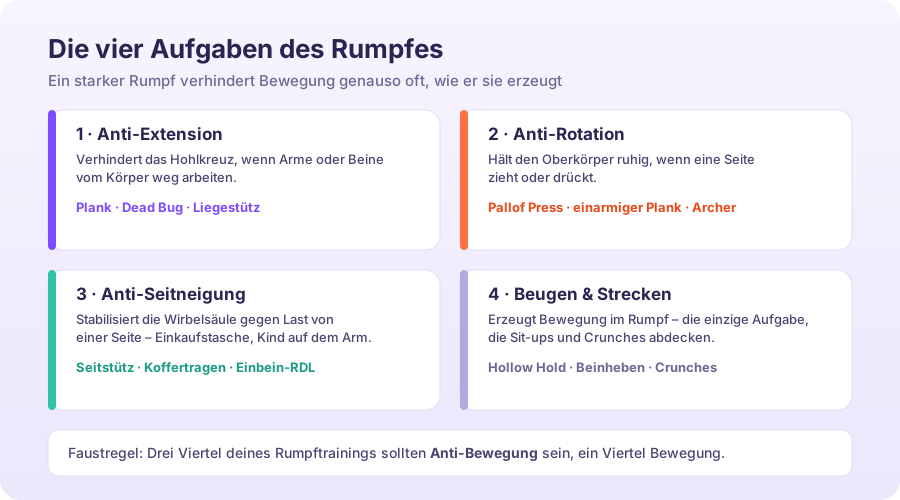
1. Anti-extension
The most important job. Whenever the arms or legs work away from the body — in a push-up, carrying something overhead, running — gravity pulls the lumbar spine into hyperextension. The abs and glutes push back against it. Plank and dead bug are pure anti-extension exercises — and so is every push-up, as described in the article Which Muscles Do Push-Ups Train?
2. Anti-rotation
When only one side is working — pressing with one arm, standing on one leg, carrying a bag in one hand — the torso wants to twist. The obliques prevent that. Exercises: Pallof press with a band, plank with one arm lifted, archer push-ups, one-arm rows.
3. Anti-lateral-flexion
Load on one side — a child on your arm, a suitcase — tips the spine sideways. Side planks, suitcase carries (farmer's carry with one hand), and single-leg deadlifts train the lateral core wall and the quadratus lumborum, which is involved in almost every case of back pain.
4. Flexion and extension
The only job in which the core generates movement — and the only one covered by sit-ups and crunches. Used sparingly: hollow hold (a hold in slight flexion, the gymnast's base position), leg raises, and crunches with a small range of motion instead of a full sit-up.
The "Big Three" — the minimal program for a healthy back
From his measurements, McGill distilled three exercises that cover all four jobs with minimal spinal load. They're now standard in back rehabilitation and a complete core program for anyone with ten minutes a day:
- Curl-up. Lying on your back, one knee bent, hands under your lower back. Lift your head and shoulders only a few centimeters — your lower back keeps its natural curve. Hold for 10 seconds. This is the crunch that spares your discs.
- Side plank. On your forearm, body in a straight line — on your knees at first, then on your feet. Hold for 10 seconds, switch sides.
- Bird dog. On all fours, extend the opposite arm and leg horizontally, core absolutely still. Hold for 10 seconds, switch.
The scheme: instead of long holds, several short 10-second reps — say 5, 3, 1 reps with short rests ("descending pyramid"). Core endurance comes from many short contractions, not one long one where form falls apart.
Plank: the most-performed and most-often-wrong exercise
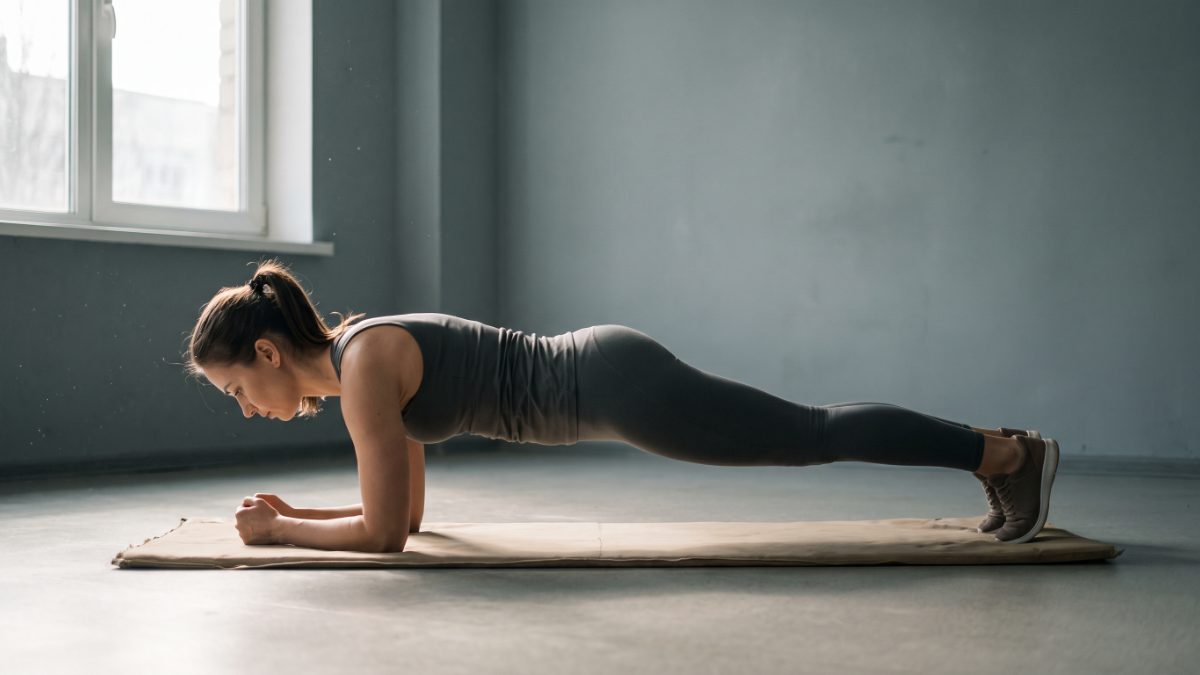
The plank is so simple it barely seems possible to get wrong — and yet most planks are ineffective. The difference is in the tension:
- Engage your glutes and tuck your pelvis slightly. That removes the lower-back arch and shifts the work from the back to the abs. The plank instantly gets harder.
- Actively press your elbows into the floor and pull your shoulder blades apart — that engages the serratus and protects the shoulder.
- Tense your whole body: thighs, glutes, abs, fists. A good plank is uncomfortable after 20 seconds, not a three-minute wait.
It follows from this logic: multi-hour plank world records are a matter of endurance and positioning, not core strength. In practice: if you can hold 60 seconds with maximal tension, don't hold longer — get harder. Lift an arm, lift a leg, elevate your feet, or switch to a dynamic variant like plank-to-push-up.
The progression: from zero to hollow hold
| Stage | Exercises | Goal for the next stage |
|---|---|---|
| 1 · Base tension | Dead bug (arms only), knee plank, glute bridge | Dead bug 3 × 10 per side without arching; knee plank 3 × 30 s |
| 2 · Big Three | Curl-up, side plank (knees), bird dog | Pyramid of 5-3-1 × 10 s each, pain-free twice daily |
| 3 · Full-body plank | Forearm plank with full tension, side plank on feet, dead bug (arm + leg) | Plank 3 × 45 s with full tension; side plank 3 × 30 s per side |
| 4 · Anti-rotation | Plank with arm lift, Pallof press, slow mountain climbers | Plank with arm lift 3 × 8 per side without hip rotation |
| 5 · Hollow body | Hollow hold (knees bent → legs straight), hanging leg raises | Hollow hold 3 × 30 s with straight legs, lower back on the floor |
Each stage typically takes two to four weeks with three short sessions per week. Core training tacks on well to any other session — ten minutes at the end is enough. The hollow-body position from the final stage is the foundation for pull-ups, handstands, and all advanced bodyweight exercises; anyone who masters it notices the difference immediately, as described in the article Learning Pull-Ups.
Core and back pain
Nonspecific back pain is the most common reason for doctor visits in the working population. The evidence here is clear and sobering at once: movement helps, almost any movement — a network meta-analysis by Owen et al. (2020) found similarly good effects for stabilization training, Pilates, and strength training, all clearly better than doing nothing. There's no specific miracle cure. What matters is consistency, avoiding repeated flexion under load during an acute phase, and building core endurance. The Big Three are the safest starting point for that. For radiating pain, numbness, or loss of strength in the legs, the back belongs in medical hands first.
What about the six-pack?
Visible abs depend ninety percent on body fat percentage, not on training. A core that can hold a plank, side plank, and hollow hold has plenty of muscle for any six-pack — whether you can see it is decided in the kitchen. The advantage of the training described here is that it builds abdominal muscle without loading the spine; sit-ups aren't necessary for looks either.
Conclusion
The core is a stabilization system: three of its four jobs consist of preventing movement. Good core training is therefore three-quarters holding against resistance — plank, side plank, dead bug, bird dog, hollow hold — and only one-quarter bending. Ten minutes, three times a week, through five stages from zero to hollow hold: that's all a healthy, resilient back needs.