
The short answer — and why it's not enough
Ask ten people at the gym which muscles a push-up trains, and you'll get the same answer ten times: chest, triceps, shoulders. That's true. But it's about as complete as saying a car consists of an engine, wheels, and a steering wheel. A clean push-up is a full-body exercise in which roughly a dozen muscle groups, from the finger flexors down to the toes, are involved with clearly divided roles — and depending on where you place your hands, how high your feet are, and how deep you go, the workload shifts noticeably between them.
This article gets to the bottom of the question: who's actually doing the pushing? Who's stabilizing? How much weight are you really moving? And what do the electromyography (EMG) studies of the last twenty years say about tailoring the exercise to specific muscles? If you're just looking for the execution, you'll find it in the wiki entry for the standard push-up. Here, it's about the why behind it.
The three main players: who does the work
Mechanically, a push-up is a horizontal press — the same movement as a bench press, except you move your own body instead of a barbell. Three muscles supply the bulk of the force.
Pectoralis major (chest)
The pectoralis major is the fan-shaped muscle that runs from the collarbone and sternum to the upper arm. Its main job in the push-up is horizontal adduction — it pulls the upper arm across the front of the body as you push away from the floor. It has two parts: the clavicular (upper) portion, which works harder with elevated feet and a slightly upward pressing angle, and the larger sternal (middle/lower) portion, which dominates in the classic and incline push-up. In the bottom position, the chest is most stretched and simultaneously under the highest load — the moment the strongest growth stimulus occurs.
Triceps (triceps brachii)
The three-headed arm extensor is responsible for elbow extension. It handles mostly the second half of the upward movement, once the chest has already left its mechanically favorable range. The narrower your hands, the greater its share. The triceps makes up roughly two-thirds of upper-arm volume — anyone who wants "big arms" can't skip it, and narrow push-ups are one of the best equipment-free exercises for it.
Anterior deltoid (front shoulder)
The front portion of the shoulder musculature assists the chest in moving the arm forward and stabilizes the shoulder joint throughout the rep. With elevated feet (decline) and during pike push-ups, the load shifts noticeably here — the pike push-up is essentially a vertical pressing movement, making it the bodyweight version of the shoulder press.
The silent helpers: who stabilizes
What distinguishes the push-up from the bench press isn't the pressing motion — it's everything around it. On a bench, your core lies supported; here, you have to hold it yourself. That's exactly why the exercise activates muscles that stay dormant during bench press.
- Serratus anterior ("boxer's muscle"). It sits along the side of the ribcage under the shoulder blade and pulls it forward (protraction). In the top position, as you actively push the floor away and the upper back rounds slightly, it works hardest. The "push-up plus" variant — a deliberately exaggerated protraction at the end of every rep — has been used in shoulder rehabilitation since a study by Ludewig et al. (2004), because it engages the serratus more strongly than almost any other exercise. A strong serratus is the best insurance against shoulder problems during pressing.
- Core (rectus abdominis, obliques, spinal erectors). Your midsection holds you in a straight line — the push-up is essentially a plank with moving arms. Freeman et al. (2006) showed that core activation during a push-up is comparable to that of a forearm plank, and clearly higher for unstable or one-arm variants.
- Glutes and quads. The gluteus maximus and quadriceps keep the hip and knee extended. They aren't trained for growth in the process, but without their engagement the hip sags — the most common form breakdown of all (more in the 7 most common push-up mistakes).
- Rotator cuff. Four small muscles that keep the head of the upper arm centered in the socket. They work isometrically on every rep — and they're the reason elbow angle matters so much (more on that shortly).
- Forearms and hands. The finger flexors and wrist stabilizers distribute load across the palm. Anyone who trains push-ups at higher volume develops noticeably stronger forearms — and anyone who neglects them gets wrist pain (see Pain During Push-Ups).
How much weight are you really moving?
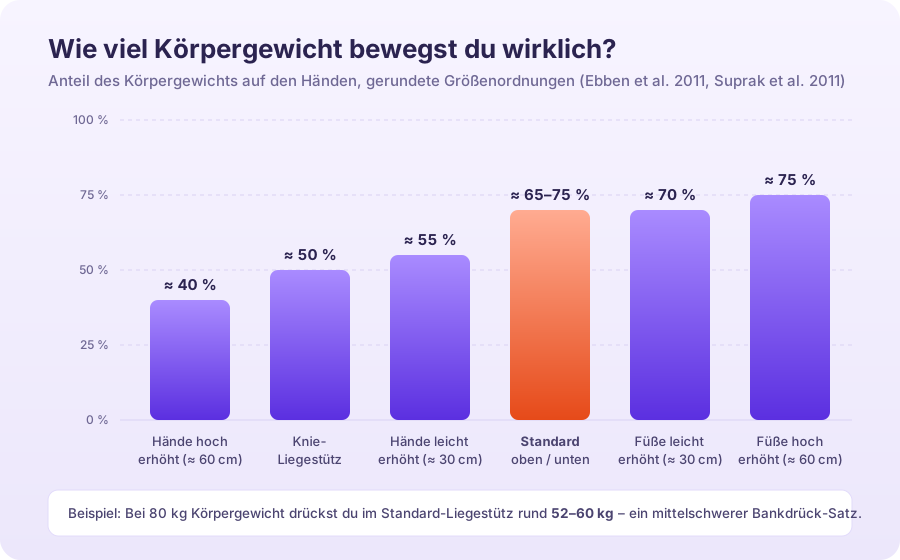
"Just bodyweight" sounds harmless. Measurements on force plates say otherwise. Two research groups — Ebben et al. (2011) and Suprak et al. (2011) — systematically measured what share of bodyweight rests on the hands across different variants. The rough figures:
| Variant | Share of bodyweight (approx.) | For 80 kg, that's |
|---|---|---|
| Hands highly elevated (≈ 60 cm) | 40% | 32 kg |
| Knee push-up | 50% | 40 kg |
| Hands slightly elevated (≈ 30 cm) | 55% | 44 kg |
| Standard, top position | 65% | 52 kg |
| Standard, bottom position | 75% | 60 kg |
| Feet slightly elevated (≈ 30 cm) | 70% | 56 kg |
| Feet highly elevated (≈ 60 cm) | 75% | 60 kg |
Two things stand out. First: a standard push-up for an 80-kg person is, in the bottom position, a 60-kg bench press — not "light bodyweight training." Second: the difference between standard and feet-highly-elevated is smaller than it feels. Decline push-ups feel heavier mainly because the load shifts toward the shoulder and upper chest, not because so much extra weight is added. Anyone who really wants to increase the load eventually needs unilateral variants or added weight — more in the article Building Muscle With Push-Ups.
Hand position: what the EMG data show
The common rule of thumb is: "wide for chest, narrow for triceps." The data tell a more nuanced story. In the most widely cited study on the topic, Cogley et al. (2005) had participants perform push-ups with narrow, shoulder-width, and wide hand positions and measured triceps and pectoralis major activation via surface EMG. Result: the narrow position produced the highest activation — in both muscles. The wide position was lowest for both.
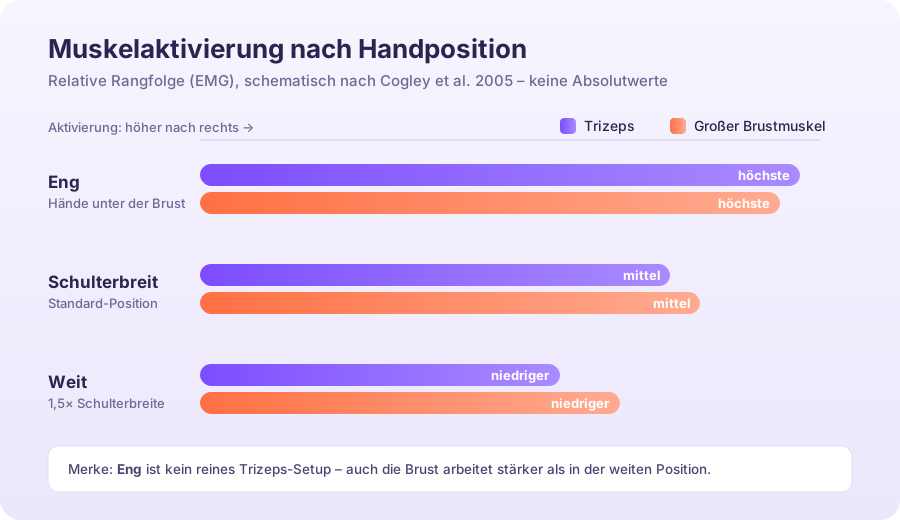
Why is that? With a narrow hand position, the lever path is longer: the elbows travel farther, the upper arm moves through a greater range of horizontal adduction, and both muscles have to work over a longer distance. The wide position shortens that path — the rep gets easier, not more chest-focused. A second study (Gouvali & Boudolos, 2005) reached similar conclusions: hand position mainly changes the leverage at elbow and shoulder — the wide position offers no activation advantage.
The practical takeaway: the shoulder-width push-up with elbows at roughly 45 degrees to the torso isn't the boring compromise — it's the biomechanical sweet spot of activation and joint health. Narrow variants like the diamond push-up are the choice when you want to maximally challenge both triceps and chest — and the wide position is more of an easier option for beginners than a chest-specialization tool.
Movement phase and tempo
Every rep has two halves with very different characteristics:
- Eccentric (downward). The muscles lengthen under load. This phase is stronger in terms of force output — you could control significantly more weight lowering than pressing up — and it's the main driver of muscle soreness and growth stimulus. Beginners who can't yet do a single push-up should start with slow negatives: 3–5 seconds lowering, then back up with knees down.
- Concentric (upward). The muscles shorten. The weakest point sits just above the floor, where the chest is maximally stretched — the "sticking point." This is where a rep succeeds or fails.
Range of motion matters too. Full depth (chest a few centimeters above the floor) stretches the chest under load more, and that stretched position is currently considered especially effective for growth in hypertrophy research. Half reps rack up more numbers in the log but build less muscle. How to coordinate tempo with breathing is covered in the article How to Breathe Properly During Push-Ups.
Which variant for which muscle?
With this knowledge of levers, angles, and load, you can target the push-up deliberately. The following overview maps common variants to their focus — all are described with execution in the push-up wiki.
| Focus | Variant | Why |
|---|---|---|
| Overall chest | Standard, full depth | Best balance of activation and joint health |
| Upper chest, front shoulder | Decline (feet elevated) | Upward pressing angle shifts load to the clavicular portion |
| Lower/middle chest | Incline (hands elevated) | Flatter angle, less load — ideal for building up |
| Triceps | Diamond, narrow position | Longest lever path for elbow extension |
| Shoulder | Pike push-up | Nearly vertical press, bodyweight shoulder press |
| Serratus anterior | Push-up plus (protraction at the top) | Targeted shoulder-blade movement at the end of the range |
| Core | Archer, one-arm, unstable surface | Asymmetric load forces rotational control |
| Forearms, wrists | Fist push-up, fingertip push-up | Neutral wrist or high grip-strength demand |
What push-ups don't train
As complete as the exercise is for the front of the body, the back of your upper body stays largely untouched. The lats, rhomboids, middle and rear deltoids, and biceps get practically no work from push-ups. Anyone who only presses for months builds a muscular imbalance: shoulders pulled forward, a rounded upper back, and elevated risk for exactly the shoulder problems a strong serratus is supposed to prevent. Most trainers' rule of thumb is one pull per push: for every set of push-ups, one set of rows, pull-ups, or at least band pulls. The legs need their own exercises too — squats and lunges are in the exercise wiki.
Conclusion
A push-up is a pressing exercise for the chest, triceps, and front shoulder — but it's also a moving plank for the core, glutes, and shoulder-blade stabilizers. You move between half and three-quarters of your bodyweight in the process, and hand position shifts the workload less than the rules of thumb claim: narrow activates more, wide activates less, shoulder-width is the best compromise. Anyone who knows the anatomy can target the exercise deliberately — and knows where it hits its limits.