

The myth of "bodyweight isn't enough"
Hardly any sentence gets repeated as often in strength training circles as this one: "You can't build muscle with push-ups, you need weights for that." It sounds plausible — after all, every gym is full of heavy dumbbells and broad backs. It's wrong anyway, at least stated so broadly. Muscle physiology doesn't distinguish between a dumbbell and your own body. It only recognizes tension, fatigue, and repetition over time. Whether that tension comes from cast iron or from 60 kilograms of your own bodyweight makes no difference to the muscle fiber.
What's true about the myth: bodyweight training makes it harder to consistently meet the conditions for muscle growth, because you can't just add 2.5 kilograms to the load. This article explains what those conditions are, what the studies on push-ups actually measured, and how to organize progressive overload without a single weight plate.
What makes muscles grow
Sports science has converged on three drivers of hypertrophy over the last fifteen years. The review article by Schoenfeld (2010) remains the standard reference for this to this day:
- Mechanical tension. The muscle fiber must work against meaningful resistance — and over the full range of motion. By far the most important factor.
- Proximity to muscular failure. Only in the last reps of a set are the large, growth-capable muscle fibers fully recruited. A set that ends with ten reps left in the tank barely produces a stimulus — no matter how many reps it had.
- Weekly volume. The number of hard sets per muscle group per week determines how strongly the stimulus accumulates. A meta-analysis by Schoenfeld et al. (2017) found a clear dose-response relationship: more sets, more growth — with diminishing returns starting at around ten to twenty sets per week.
None of these points mention dumbbells. If a set of push-ups creates mechanical tension, comes close to failure, and is part of an adequate weekly volume, it builds muscle. Full stop.
The studies: push-ups versus bench press
This question has been directly studied — and the results are remarkably consistent.
- Kikuchi & Nakazato (2017). Young, untrained men trained for eight weeks with either bench press at 40% of their one-rep max or push-ups, both to muscular failure. The study found comparable increases in triceps and chest muscle thickness in both groups, along with similar strength gains — at the same training frequency.
- Kotarsky et al. (2018). Here, a progressively loaded push-up variant (with elevated feet and added weight when needed) was compared over four weeks to classic bench press at 40% of one-rep max. The results: similar improvements in strength and muscle thickness. The authors explicitly conclude that push-ups are an equivalent alternative to light bench press — as long as progression is applied correctly.
- Calatayud et al. (2015). This study compared bench press with push-ups adjusted via an elastic band to a comparable EMG activation level. After five weeks, strength gains were equal in both groups. The takeaway: it's not the exercise that decides, it's the muscle activation it produces.
One honest caveat: all three studies compared push-ups with light bench press and ran for only four to eight weeks with untrained participants. They prove that push-ups work as a hypertrophy stimulus. They don't prove that an advanced athlete after two years of training achieves the same results with push-ups as with heavy bench press. More on that below.
The rep-range continuum
The second big question is how many reps a set should have. For a long time, the rule was: 8–12 for muscle growth, anything above that is "endurance." The meta-analysis by Schoenfeld et al. (2017) on light versus heavy loads corrected that picture: as long as a set goes close to muscular failure, muscle growth is practically the same across loads between about 30% and 80% of one-rep max. For push-ups, that means: sets of 6 to around 30 reps build muscle about equally well — if they're hard.
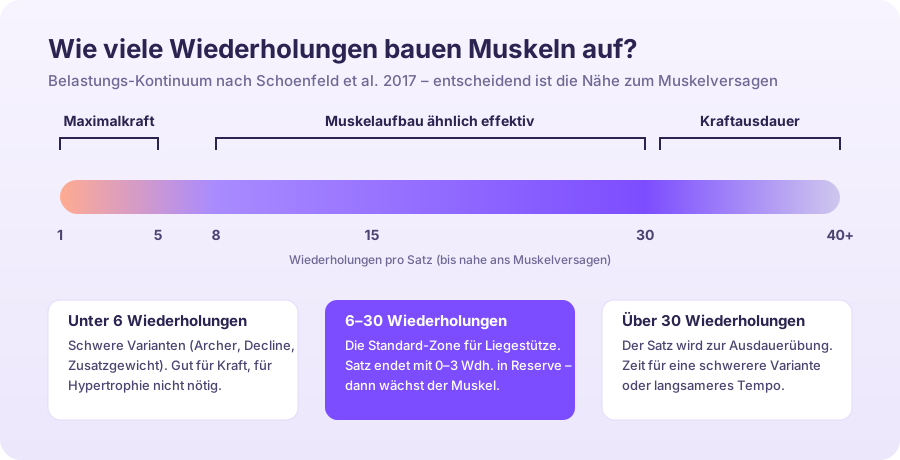
From this follow two rules that make the difference between "doing push-ups" and "building muscle with push-ups":
- End building sets with 0–3 reps in reserve. If you could have done five more reps after the set, it was largely wasted for hypertrophy. That doesn't mean every set has to go to complete collapse — the evidence (e.g. Refalo et al., 2023) shows that one to three reps in reserve works almost as well and is considerably easier to recover from.
- Switch to a harder variant once you can do more than 30 clean reps. Beyond that, the set turns into an endurance exercise: the fatigue comes from your heart and metabolism, not from the muscle fiber. High numbers are great for tests and challenges — for growth, you then need a harder variant.
Progressive overload without dumbbells
This is where the real skill lies. With a dumbbell, progression is trivial: one more plate. With bodyweight, you have to increase the load differently — and there are more levers for it than most people use.
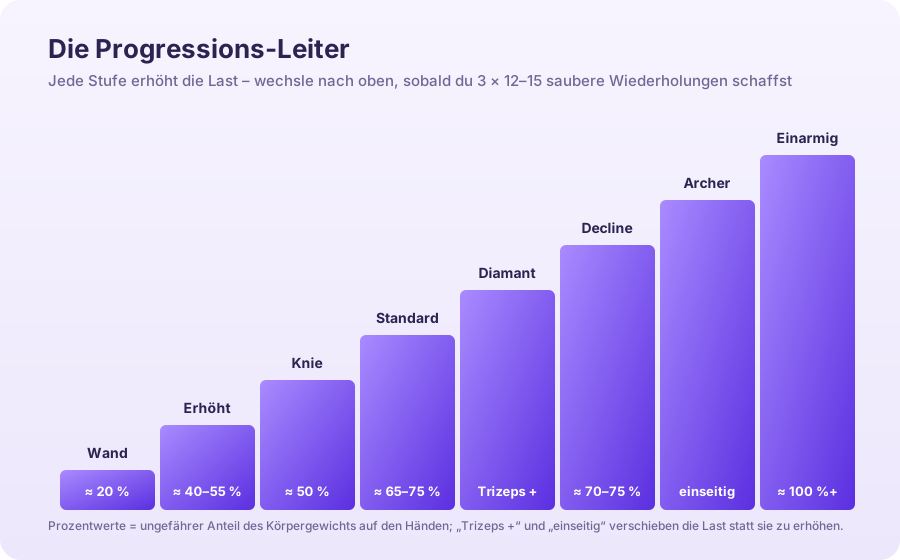
- Change the lever. The ladder above is essentially a lever scale: hands elevated (less load), feet elevated (more load and a different angle), asymmetric variants like archer push-ups all the way up to the one-arm push-up. How the percentages work is explained in the article on push-up anatomy.
- Slow down the tempo. Three seconds down, one second pause at the bottom, explosive up — the same rep with three times as much time under tension. A set of 20 fast reps becomes a set of 12 very hard ones this way.
- Increase the range of motion. Push-ups on handles, books, or parallettes let you bring your chest lower than your hands. That extra stretch under load is one of the strongest hypertrophy stimuli there is.
- Shorten rest periods. From three minutes down to 90 seconds between sets — at the same rep count, stimulus density goes up. Not endlessly scalable, but a good intermediate step.
- Add weight. A backpack loaded with books or water bottles is the most honest progression: it genuinely increases the weight. Five extra kilograms in the backpack, at around 65% of bodyweight loaded, is roughly like adding 7–8 kilograms of bodyweight to the push.
- More sets. The simplest form: going from 3 to 4 to 5 hard sets per session. That's volume progression, and it's remarkably effective over months.
Only one thing matters: it has to be measured. Progression that isn't logged usually doesn't happen. Anyone who keeps their sets, variants, and reps in a tracker can see in black and white after four weeks whether the curve is climbing — and where it's time for the next stage.
Weekly volume, frequency, and rest
The meta-analyses provide usable guardrails:
- Volume: 10–20 hard sets per muscle group per week. For chest and triceps, all pushing variants count together.
- Frequency: Two to three sessions per week per muscle group spread the volume better than a single marathon session. Daily training is possible, but then needs significantly fewer sets per day — see daily push-ups.
- Rest: 1.5 to 3 minutes between hard sets. Shorter rest lowers the rep count in the next set and therefore the effective volume.
Sample week for advanced trainees (standard push-up ≈ 25 reps)
| Day | Exercise | Sets × reps | Goal |
|---|---|---|---|
| Monday | Decline push-up (feet 40 cm elevated) | 4 × 8–12 | Upper chest, shoulder — mechanical tension |
| Monday | Rows on a table or with a band | 4 × 10–15 | Pull balance |
| Wednesday | Diamond push-up | 4 × 10–15 | Triceps, chest |
| Wednesday | Push-up on handles, 3-s negative | 3 × 8–10 | Stretch under load |
| Friday | Archer push-up | 4 × 6–8 per side | Unilateral load, core |
| Friday | Standard push-up, 5–10 kg backpack | 3 × 10–15 | Added load |
That comes out to 18 pushing sets for chest and triceps per week, spread across three days, using four different progression mechanisms. Adjust the rep counts so every set ends with 1–3 reps in reserve — as soon as the top of the range falls within reserve, it's time for the next stage.
Nutrition and recovery
The best stimulus goes to waste without raw material. The meta-analysis by Morton et al. (2018) found that muscle gains rise with protein intake up to about 1.6 g per kilogram of bodyweight per day; if you want to play it safe, aim for 1.6–2.2 g. For a 75-kg person, that's 120–165 g of protein daily, spread across three to four meals. Add a slight calorie surplus (200–300 kcal), seven to nine hours of sleep, and — often forgotten — genuine rest days. Muscles grow between sessions, not during them.
Where push-ups hit their limits
Fairness requires naming the limits clearly:
- The backside is missing. Back, rear shoulder, and biceps aren't trained. Without pulling exercises (pull-ups, rows), an imbalance builds up that can lead to shoulder problems over months.
- The legs are missing entirely. Squats, lunges, and single-leg variations belong in every full-body plan.
- The load eventually maxes out. Anyone who can do 10 reps of a one-arm push-up is moving more than their bodyweight with a single arm — but the ladder doesn't go further from there. From here on, rings, added weight, or the dumbbell after all bring the next stage.
- Measurability is worse. "5 kg more on the bar" is unambiguous. "Feet 10 cm higher" isn't. That makes consistent logging all the more important.
For most people — beginners, returners, frequent travelers, anyone without a gym — these limits simply aren't relevant in the first one to two years. The muscle you build with push-ups in that time is the same muscle you would have built with dumbbells.
Conclusion
Building muscle with push-ups works — the studies show it unambiguously, as long as three conditions are met: the sets are hard, the weekly volume is right, and the load rises over time. The tools for that are levers, tempo, range of motion, added weight, and set count. What you need isn't a gym — it's a system, and the discipline to log it.