

The most honest exercise in the world
A pull-up can't be faked. Either your chin clears the bar or it doesn't. There's no lighter dumbbell, no shorter lever, no help from a spotter — just you, your bodyweight, and the muscles of your backside. That's exactly what makes it perhaps the best measure of relative strength, and exactly what makes it so frustrating for beginners: if you can't do one yet, you can't practice it "a little bit" either.
The good news: the first pull-up isn't a matter of talent, it's a matter of building up. Almost every healthy adult can achieve one within six to twelve weeks — provided they train the right precursor exercises in the right order. This article explains which muscles the pull-up requires, why it's so hard without the precursor stages, and walks you stage by stage to your first rep.
Which muscles a pull-up requires
The pull-up is vertical pulling: you pull your body up toward your fixed hands. Involved are:
- Latissimus dorsi. The broad back muscle is the primary driver. It pulls the upper arm down toward the body from above — the movement that defines the pull-up. A well-developed lat is the reason for the V-shaped torso.
- Biceps and brachialis. Flex the elbow. In the chin-up (palms toward you), they take on more of the load; in the pull-up (palms away), less. That's why the chin-up is the easier entry variant for most people.
- Shoulder-blade muscles. The trapezius (lower portion) and rhomboids pull the shoulder blades down and together. This movement — scapular depression — is the first phase of every clean pull-up, and the one beginners skip most often.
- Forearms and grip. The finger flexors hold you on the bar. For many beginners, it's not the back that gives out first, but the grip.
- Core. Holds the body in a slight hollow-body position so no momentum builds up. A pull-up is also a core exercise.
Why the first pull-up is so hard
In a push-up, you move about two-thirds of your bodyweight. In a pull-up, it's 100 percent — plus the fact that the muscles involved are practically never called on in daily life. We push doors, carry bags, stand up; but we never pull ourselves up anywhere. Most people's lats are simply untrained. On top of that comes a biomechanical detail: in the bottom position, in the full hang, the lat is maximally stretched and mechanically at its weakest. That's exactly where every rep begins.
The strength-to-bodyweight ratio is the decisive factor. Someone who loses 10 kilograms of body fat gains as much toward their pull-up as they would through months of strength training. Both paths together are fastest — but the training path always works, regardless of body weight.
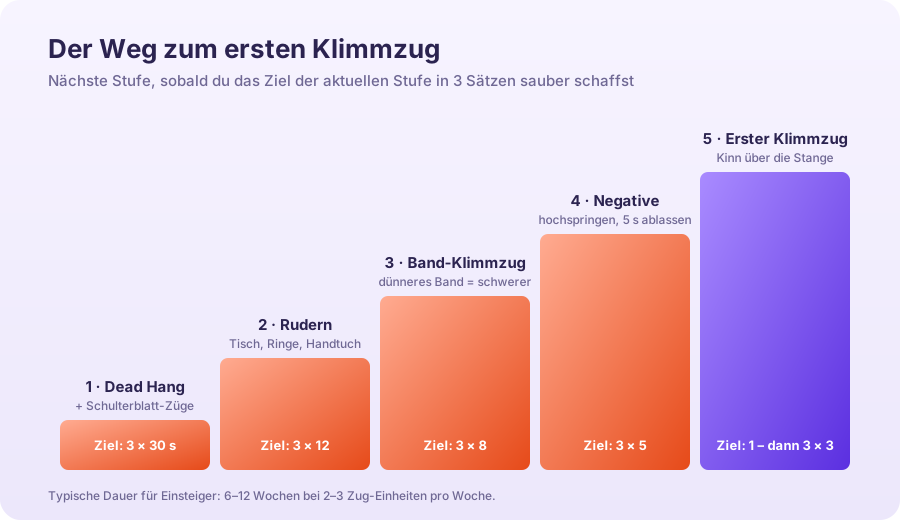
The five stages to your first pull-up
Stage 1: Dead hang and scapular pulls
Hang from the bar, arms straight, shoulders relaxed — that's the dead hang. It builds grip strength, stretches the lat and shoulder, and gets the tendons used to the load. Goal: three times 30 seconds. Then add scapular pulls: from the hang, pull the shoulder blades down so the body rises a few centimeters, without bending the elbows. Hold, release. This is the first phase of every pull-up, practiced in isolation. Goal: three times 8.
Stage 2: Rows
Horizontal pulling trains the same muscles with less bodyweight involved. Under a sturdy table, on gymnastic rings, on a low-hanging bar, or with a towel around a door handle: rows with the body in a straight line, pulling your chest toward the edge. The more horizontal your body, the harder it gets. Goal: three times 12 with a near-horizontal body. Rows stay in the program even after your first pull-up — it's the horizontal pull pattern described in the article on the six fundamental movements.
Stage 3: Band-assisted pull-ups
A resistance band looped around the bar, with your foot or knee in the loop. The band takes the most weight off at the bottom — where you're weakest — and the least at the top: exactly the right profile. Start with a thick band and switch to thinner ones once you can hit three times 8. If you don't have a band, a chair with one foot lightly assisting works too — only as much help as needed.
Stage 4: Negative pull-ups
The single most effective exercise on the way to your first pull-up. Jump or step up into the top position (chin over the bar), then lower yourself as slowly as possible — aim for five seconds, until your arms are fully extended. Muscles are noticeably stronger in the eccentric phase than the concentric phase, so you can already work with full bodyweight here, before you can pull yourself up. Goal: three times 5, each with a five-second descent. Be careful with volume — negatives cause serious muscle soreness. Two sessions per week is enough.
Stage 5: The first pull-up
Once you can do three sets of 5 slow negatives, your first pull-up is usually just days away. Test it fresh at the start of a session, with a chin-up grip (palms toward you), shoulder blades down first, then pull the elbows toward your hips, chest toward the bar. Chin over the bar counts. After that: the first pull-up becomes three sets of 3 with rests, then three sets of 5, then pull-ups with an overhand grip.
The 8-week roadmap
| Week | Session A (e.g. Monday) | Session B (e.g. Thursday) |
|---|---|---|
| 1–2 | Dead hang 3 × max, scapular pulls 3 × 8, rows 3 × 8–12 | Rows 4 × 8–12, dead hang 3 × max |
| 3–4 | Band pull-ups 3 × 6–8, rows 3 × 12 | Negatives 3 × 3 (5 s), scapular pulls 3 × 10 |
| 5–6 | Negatives 3 × 5 (5 s), rows 3 × 12 (feet elevated) | Band pull-ups 4 × 6 (thinner band), dead hang 3 × 45 s |
| 7–8 | Test: 1 pull-up, then negatives 3 × 5 | Band pull-ups 3 × 8, rows 3 × 15 |
Each session takes 20 minutes and can be tacked onto a regular workout — ideally after your push exercises, to balance out the pull-to-push ratio. Rest between sets: two to three minutes. Shorter doesn't help here — the back needs the recovery to deliver quality again in the next set.
The most common mistakes
- Kipping and momentum. The body swings, the legs kick. That's a different exercise (from CrossFit), not the strict pull-up you're trying to learn. Hold hollow-body tension: abs tight, legs slightly forward, glutes engaged.
- Half reps. Chin not over the bar at the top, elbows not fully extended at the bottom. Full range of motion counts — even if it means fewer reps.
- Shoulders up by your ears. Shrugging your shoulders in the hang loads the shoulder joints passively. Shoulder blades down — always first.
- Too much, too soon. The tendons of the elbow and forearm adapt more slowly than muscles. Pain on the inside of the elbow ("golfer's elbow") is the classic sign of too much pull-up volume in too little time. Two sessions per week is enough for building up.
- Only pulling, never pushing. The reverse imbalance. Push-ups and dips still belong in the program — the article on joint pain explains why the balance of both patterns matters for the shoulder.
After your first: where to go from here
Going from one to ten pull-ups usually takes longer than going from zero to one — but the path is the same: sets close to your max, two to three sessions per week, volume increasing slowly. A proven scheme is "grease the groove": several small sets spread across the day (say, five sets of 2 reps), never to failure. Once you can do 8–10 clean reps, added weight in a backpack, slow weighted negatives, or variations like archer pull-ups come into play. Log every session — grip variant, sets, reps, band strength. Progress on the pull-up is slow enough that it's easy to miss without a log.
Conclusion
The pull-up isn't an exercise for the talented — it's an exercise for the patient. Dead hang, rows, band, negatives — and eventually your chin clears the bar. Anyone who honestly works through the stages without overloading their tendons achieves their first pull-up within one to three months, and ends up with a back that makes everything else in training better.