

A debate that shouldn't have to exist
For about fifteen years, two camps have been arguing. One says: high-intensity interval training (HIIT) delivers in twenty minutes what others need an hour for. The other says: easy, steady-state training in "Zone 2" is what pros spend eighty percent of their time doing, and it's what matters for mitochondria, fat metabolism, and longevity. Both are right — and both are describing only half the picture. This article explains what happens in your body at each intensity, what the studies actually show, and how to fit both into one week without sacrificing your strength training.
Why endurance matters at all: VO₂max and life expectancy
The single strongest predictor of life expectancy known to sports medicine is cardiorespiratory fitness — measured as maximal oxygen uptake, VO₂max. In a cohort study of over 120,000 patients (Mandsager et al., 2018, JAMA Network Open), people with the lowest fitness had a higher mortality risk than smokers, diabetics, or people with high blood pressure — and the curve didn't flatten out among the fittest: those in the top group lived even longer than the well-trained. Unlike almost any medication, there's no ceiling on the benefit.
VO₂max declines by about ten percent per decade starting at age thirty — if you do nothing. Training can more than halve that decline, and that's exactly where the two camps come in: Zone 2 lays the foundation, HIIT raises the roof.
The five training zones
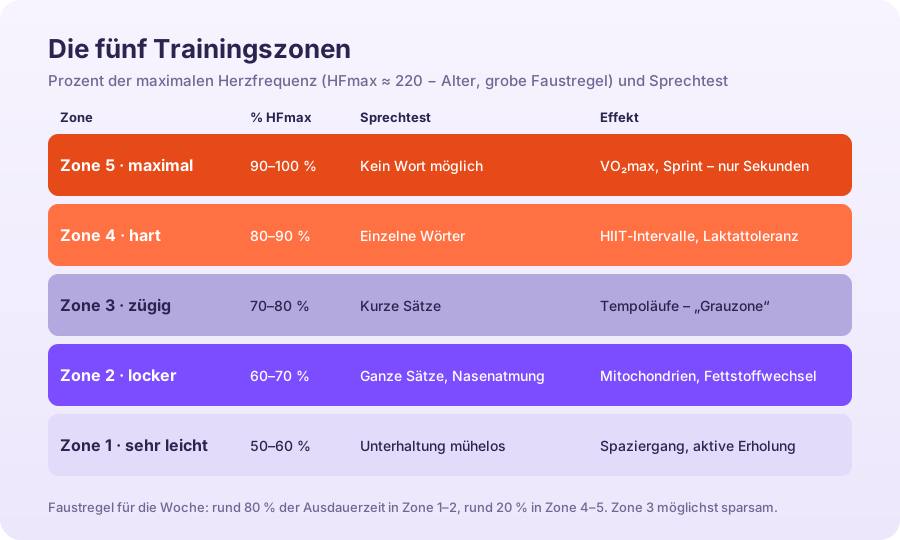
The zones are defined by percentage of maximal heart rate, but the "220 minus age" rule of thumb varies by about ±10 beats — in practice, the talk test is more reliable: in Zone 2 you can speak in full sentences and breathe through your nose, but not sing. In Zone 4, only single words come out. Zone 3, the "brisk" middle ground, is where most recreational athletes unknowingly spend almost all their training — and it happens to be the least efficient: too hard to sustain long enough, too easy for the interval effect.
What happens in Zone 2
At low intensity, muscle fibers draw their energy predominantly from fat, processed in the mitochondria — the cell's power plants. Zone 2 training is the strongest known signal to increase the number and size of these mitochondria. The consequences reach far beyond running:
- Better fat metabolism. More mitochondria means more fat used as fuel, at every intensity and at rest. That's the mechanism behind the improved insulin sensitivity that Zone 2 training produces.
- Lactate clearance. The slow-twitch fibers learn to use up the lactate produced by the fast-twitch fibers. That's why base training also speeds up recovery between hard sets in strength training.
- Low load. Zone 2 creates hardly any fatigue, hardly any stress hormones, and hardly any injury risk. You can do it every day — and that's exactly why endurance pros spend around 80 percent of their training time there (the "polarized" model, documented among others by Seiler, 2010).
The catch: Zone 2 takes time. Under 30 minutes per session, little happens; the relevant adaptations kick in at 45–90 minutes and multiple sessions per week. Brisk walking, easy running, cycling, rowing, swimming — anything you can sustain while speaking in full sentences counts.
What makes HIIT so efficient
High-intensity intervals — say, four minutes hard, three minutes easy, repeated four times (the "Norwegian 4×4") or 30 seconds all-out with four minutes of rest — apply a different stimulus: they push the heart close to its maximal output. The heart responds like a muscle and gets stronger. The work of Gibala et al. showed starting in 2006 that just a few minutes of hard intervals per week produce many of the adaptations that would otherwise require hours of steady-state training — and a meta-analysis by Milanović et al. (2015) confirmed that HIIT raises VO₂max more than moderate steady-state training.
The cost: HIIT is exhausting, taxes joints and nervous system, and can't be done daily. Two sessions per week is the maximum for most people who also want to fit in strength training. And HIIT without a base is like a roof without a foundation: VO₂max rises quickly, then plateaus, because the mitochondrial base is missing.
Both in one week: the 80/20 rule
The solution isn't a decision — it's a distribution. For recreational athletes with two to four endurance sessions per week, this split has proven effective:
| Weekly time budget | Zone 1–2 | Zone 4–5 (HIIT) | Example |
|---|---|---|---|
| 90 minutes | 2 × 35 min | 1 × 20 min | 2 × easy running or cycling, 1 × 4×4 intervals |
| 3 hours | 2 × 60 min | 2 × 25 min | 2 × Zone 2 cycling, 1 × running intervals, 1 × burpee/jump-rope intervals |
| 5 hours | 3 × 75 min | 2 × 30 min | polarized model, as in competitive sport |
If you only fit in a single endurance session per week, make it HIIT — the effect per minute is greatest there. If you manage three or more, you gain the most from Zone 2. And you should skip Zone 3 on purpose: it feels productive, but it's the gray zone that's too tiring for recovery and too easy for adaptation.
Cardio and strength training: the "interference effect"
The worry that endurance training destroys muscle growth traces back to a study from the 1980s and is largely debunked today. A meta-analysis by Schumann et al. (2022) found that combined strength and endurance training doesn't impair hypertrophy or maximal strength as long as total volume stays reasonable — only explosive power suffers slightly. Practical rules to avoid conflicts:
- Don't do strength and HIIT on the same day, or keep at least six hours between them.
- Zone 2 pairs well with anything — even directly after strength training as an easy cooldown.
- Go easy on legs on HIIT days: if you sprint, train upper body the next day.
- Keep an eye on total load — combined strength and endurance training is the health optimum, as described in the article on the six fundamental movements.
A starting point for people who never run
If you don't currently do any endurance training, don't start with HIIT. Four weeks of Zone 2 — three sessions of 30 minutes of brisk walking or easy cycling — build the base that tendons, heart, and motivation won't fail on. From week five, add one interval session, starting short (six times 30 seconds brisk, 90 seconds easy), then longer. Log every session — duration, activity, and, if you have a watch, average heart rate. After eight weeks you'll see the progress in a single number: the same pulse at a higher pace.
Conclusion
HIIT and Zone 2 aren't competitors — they're tools for different jobs. Zone 2 builds mitochondria, fat metabolism, and the capacity to train at all; HIIT raises VO₂max, the strongest predictor of a long life. Eighty percent easy, twenty percent hard, skip the middle — that's the whole answer.