
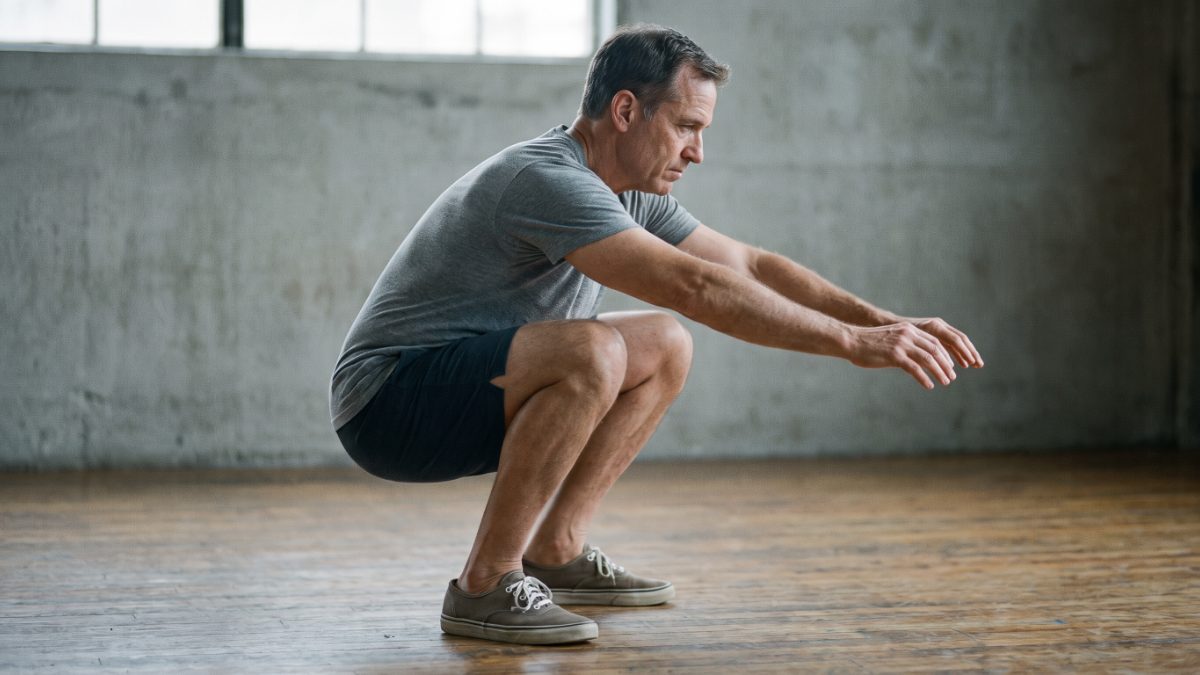
The exercise that decides independence
Getting up from a chair. Getting out of a car. Picking something up off the floor. Climbing stairs. Every one of these movements is a squat — and the ability to perform it without help is, in old age, the difference between an independent life and needing care. The "sit-to-stand test" (how many times can you get up from a chair in 30 seconds?) is one of the best predictors of fall risk and life expectancy in geriatrics. No other strength exercise has such a direct connection to daily life.
And none is surrounded by as many myths: knees must not go past the toes, don't go below parallel, only worthwhile with weight. This article clears that up, explains the anatomy and the research, and shows a progression that starts at the chair squat and ends at the single-leg variation — entirely without equipment.
Which muscles are working
- Quadriceps. The four-headed thigh extensor straightens the knee. It works in every squat, most intensely in the lower half of the movement.
- Gluteus maximus. The large glute muscle extends the hip. Its share increases with depth — in a quarter squat it barely works, in a deep squat it's the primary driver out of the bottom position.
- Adductors. The inner thigh assists hip extension, especially in the depths. The inner-thigh soreness after your first deep squats comes from here.
- Hamstrings. Work in a stabilizing role, less than often claimed. For them, you need the hinge pattern — see the six fundamental movements.
- Core and spinal erectors. Keep the torso upright. Even the bodyweight squat is a core exercise — with weight (a backpack, a child on your shoulders) even more so.
- Calves and foot muscles. Stabilize the ankle and determine how deep you can go while keeping your heels on the ground.
How deep? What the research says
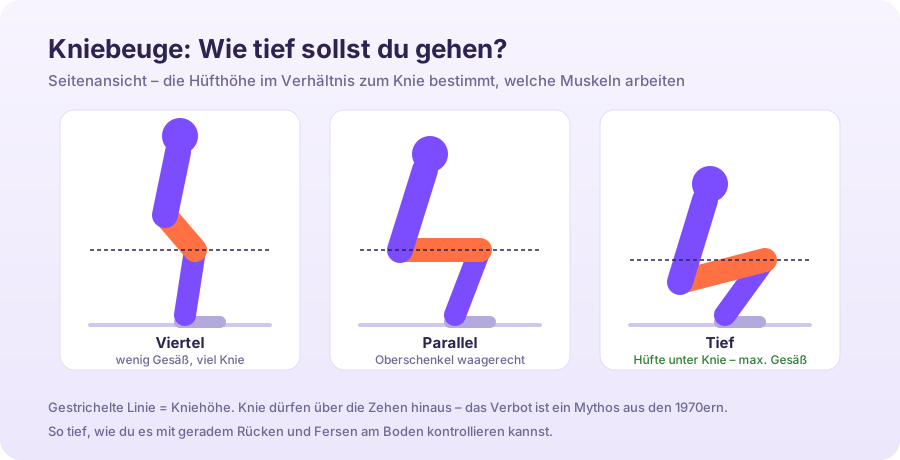
The myth that deep squats damage the knees traces back to a single study from the 1960s whose methodology has since been widely refuted. The comprehensive review by Hartmann, Wirth, and Klusemann (2013) reaches the opposite conclusion: the highest forces on the kneecap and cruciate ligaments occur at half squats around 90 degrees; at depth, the load spreads over a larger contact area and is further reduced by the contact between the upper and lower leg. Deep squats with an appropriate load are not only harmless for healthy knees, but protective: they strengthen the musculature through the full range of motion and preserve hip and ankle mobility.
Depth matters for the training effect too. A study by Bloomquist et al. (2013) compared twelve weeks of deep versus half squats: the deep group built more muscle — especially in the glutes — and improved jump power and strength across the full range of motion, while the half-squat group improved only at the trained angle.
Knees over toes: the most stubborn myth
"Your knees shouldn't go past your toes" still appears in fitness guides today. The recommendation dates back to the 1970s and was tested in a widely cited 2003 University of Memphis study: when the knees are artificially held behind the toes, knee load drops by about a fifth — but hip and lower-back load increases by nearly tenfold, because the torso has to tip forward dramatically. Your knees go past your toes on every deep squat and every flight of stairs. That's not a flaw — it's anatomy, and the longer your thighs, the more so.
What actually matters isn't the forward position of the knees, but their inward position: knees caving toward the midline (valgus) is the error that loads the cruciate ligaments and meniscus. So the rule isn't "knees behind the toes" — it's "knees tracking toward the toes."
Technique in five points
- Stance. Feet about shoulder-width apart, toes turned out 10–30 degrees. The exact width is individual — test which position lets you go deepest and stay most upright.
- Initiation. Hip and knee bend simultaneously — not hips-first (that's a hinge), not knees-first.
- Knees over the toes, pushed outward. Imagine screwing your feet into the floor as if trying to push it apart. That activates the glutes and keeps the knees in line.
- Heels down, weight across the whole foot. If your heels lift, you're missing ankle mobility — a common and fixable problem (see below).
- Torso upright, gaze slightly forward and down, core braced. A slight forward lean is normal and necessary. A rounded lower back at depth ("butt wink") is a sign you've gone as deep as you can for today.
The most common mistakes
| Mistake | Cause | Fix |
|---|---|---|
| Knees cave inward | Weak glutes (gluteus medius), lack of foot stability | Actively push knees out, band around the knees as a reminder, side leg raises and glute bridges |
| Heels lift off | Restricted ankle mobility (often from raised-heel shoes and lots of sitting) | Calf stretch against the wall, squats with heels on a book as a transition |
| Torso tips far forward | Weak quadriceps, knees held too far back, stiff hips | Consciously let the knees travel forward, extend arms forward as a counterweight, wall sits for the quads |
| Rounded lower back at depth | Hip mobility, too narrow a stance | Widen your stance, turn toes out more, hold a deep squat daily as a mobility drill |
| Only half depth | Habit, fear of going deep | Slow the tempo: 3 seconds down, brief hold at the bottom, hold a doorframe and go deeper |
Progression without equipment
The squat can be progressed from your first sit-to-stand all the way to the single-leg variation without a single weight — the principles are the same as for the push-up ladder in the article Building Muscle With Push-Ups: lever, tempo, amplitude, single-limb loading.
- Chair squat. Sit down and stand up without momentum, arms in front of your chest. Goal: 3 × 15 controlled, then without touching the chair.
- Free squat (squats) below parallel. Goal: 3 × 20 clean.
- Tempo squat. 3 seconds down, 2 seconds hold at the bottom, explosive up. Goal: 3 × 12. Follow with wall sits 3 × 45 s as a supplement.
- Lunges and step-ups (lunges, step-ups). The entry point into single-leg training. Goal: 3 × 12 per side.
- Bulgarian split squat. Rear foot on a chair or sofa — the strongest bodyweight leg exercise there is. Goal: 3 × 10 per side.
- Jump squats (jump squats, box jumps) for explosive power — only once stage 4 is solid. A quiet landing is the quality marker.
- Pistol squat. The single-leg squat — a goal for advanced trainees. Precursors: holding a doorframe, sitting onto a box, then unassisted. Requires strength, balance, and ankle mobility in equal measure.
Squatting with knee problems
Knee pain isn't a reason to avoid squats — usually it's a reason to do them correctly. For pain under or around the kneecap (patellofemoral pain, the most common case), a strong quadriceps and strong glutes are the evidence-based therapy — not rest. The entry point: wall sits, chair squats within a pain-free range, glute bridges; depth increases over the weeks as long as pain during the exercise stays under 3 out of 10 and isn't worse the next day. For locking, swelling, instability, or pain following an injury, see a doctor first — the pain traffic-light from the article on joint pain applies to the knee just as well.
The deep squat as an everyday position
In large parts of the world, the deep squat — heels on the ground, glutes near the heels — is a normal resting position in which people eat, wait, and work. In countries with chairs, this ability is almost completely lost in adulthood, and with it the mobility of hip, knee, and ankle. Reclaiming it is one of the most effective mobility projects there is: spend two to five minutes a day in a deep squat, at first holding onto a doorframe or with a book under your heels. After four to eight weeks, the position is comfortable again for most people — and the squat in training gets deeper on its own.
Conclusion
The squat is the exercise with the most direct connection to daily life and to aging. Deep is healthier than shallow, your knees are allowed to go past your toes, and the only real mistake is caving inward. From the chair to the pistol squat, there's a clear ladder that needs no equipment — just consistency, patience, and a log that shows how much deeper and stronger you've gotten since last month.