

The underrated part of training
Most trainees think carefully about their sessions: exercises, sets, reps, progression. Hardly anyone gives the same care to the 23 hours in between. Yet training itself is only a stimulus — a controlled disruption the body responds to. The actual adaptation — the muscle that grows, the heart that gets stronger, the tendon that becomes more resilient — happens during recovery. Anyone who sleeps too little, eats too little, and never takes a break is training against their own progress.
This article explains the principle of supercompensation, what the research knows about sleep and training success, how to recognize that you're doing too much — and what a realistic recovery protocol looks like for people with a job, a family, and a life.
Supercompensation: the basic model
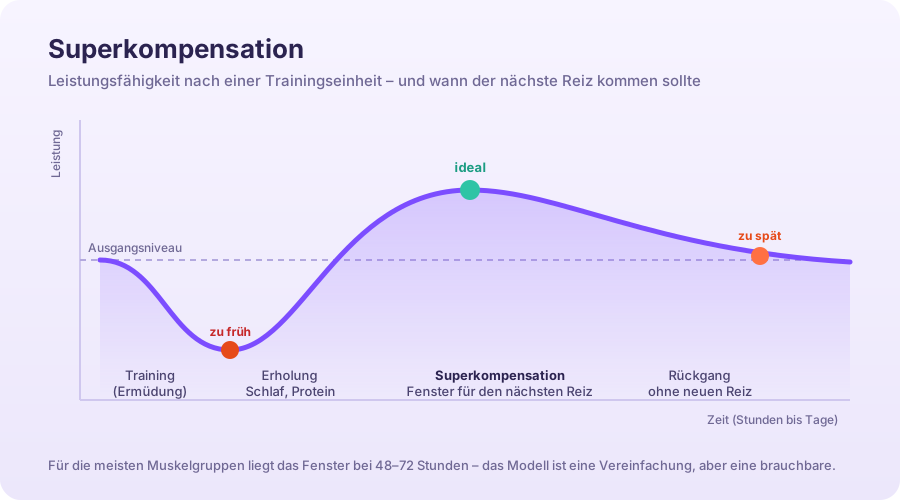
The model comes from Soviet sports science of the 1950s and is a simplification — but one that captures the essentials. After a training session, performance capacity initially drops: energy stores are depleted, muscle fibers have micro-damage, the nervous system is fatigued. During recovery, the body doesn't just repair itself — it builds back up beyond its starting level, to be ready for the next stimulus. This overshoot is supercompensation. Without a new stimulus, performance falls back to its old level.
From this follow the three classic mistakes:
- Too early: the next session hits a still-fatigued body. Performance drops in the short term, and overtraining looms in the long term.
- Too late: the window has passed, and the progress fizzles out. That's why training once a week accomplishes so little.
- Always the same: the same stimulus eventually stops producing supercompensation. That's why progression is necessary.
For most muscle groups, the window sits at 48–72 hours — the reason two to three sessions per muscle group per week show up in practically every recommendation. The nervous system and tendons recover more slowly than muscle, which is why hard weeks get tough eventually even for "rested" muscles.
Sleep: the most important recovery factor
No supplement, no ice bath, no massage comes close to what seven to nine hours of sleep deliver. The research on this is unambiguous:
- Muscle growth. Most growth hormone is released during deep sleep, and protein synthesis runs at full speed. Sleep deprivation reverses that balance: a study by Nedeltcheva et al. (2010) showed that people in a calorie deficit who got 5.5 instead of 8.5 hours of sleep lost 60% more lean mass — the body broke down muscle instead of fat.
- Strength and performance. Even a single night with less than six hours of sleep measurably lowers maximal strength, reaction time, and willingness to push hard. Over weeks, that adds up to noticeably worse progression.
- Injury risk. A study by Milewski et al. (2014) in adolescent athletes found a 70% higher injury risk with less than eight hours of sleep — a stronger effect than any training factor.
- Hormones and appetite. Sleep deprivation raises cortisol and ghrelin (hunger), lowers testosterone and leptin (satiety). Anyone who sleeps too little eats more, recovers worse, and builds less — every lever points the same direction.
Sleep hygiene that actually works
- Fixed schedule. The same wake-up time seven days a week is the strongest signal for your internal clock — stronger than bedtime.
- Light. 10 minutes of daylight in the morning, dim light in the evening. Screens are less the problem than brightness and content that keeps you alert.
- Cool and dark. 17–19 °C and a genuinely dark room measurably improve deep sleep.
- Caffeine before noon. Its half-life is five to six hours — an afternoon coffee is still half in your bloodstream at 11 p.m.
- Don't train right before bed. Hard sessions raise core temperature for two to three hours; Zone 2 training or mobility work in the evening, by contrast, barely disrupt sleep.
- Be honest about alcohol. It speeds up falling asleep and wrecks REM sleep in the second half of the night. Two drinks in the evening measurably cost you recovery.
Nutrition for recovery
Recovery needs raw material and energy. The key points supported by research:
- Protein: 1.6–2.2 g per kilogram of bodyweight per day, spread across three to four meals — as covered in the article Building Muscle With Push-Ups. A protein-rich meal before bed (around 40 g, cottage cheese or casein) demonstrably improves overnight protein synthesis.
- Carbohydrates: They refill the glycogen stores that HIIT and high volume deplete. Anyone who wants to "eat nothing" after a hard session extends their recovery by hours.
- Fluids: Two percent dehydration already measurably lowers performance. Rule of thumb: urine should be light yellow.
- What isn't necessary: The 30-minute "anabolic window" after training is a myth; total intake over the day is what matters. And no supplement replaces any of the fundamentals above.
How to tell you're doing too much
True overtraining syndrome is rare and mostly affects competitive athletes. What hits recreational athletes more often is the precursor stage: overreaching — a few weeks of too much stimulus and too little recovery. The warning signs:
| Signal | Normal after hard training | Warning sign |
|---|---|---|
| Performance | One off day | Two weeks without progress or a regression despite training |
| Morning resting heart rate | ±3 beats of variation | 5–10 beats above normal for several days in a row |
| Sleep | Deep sleep | Trouble falling asleep despite fatigue, early waking |
| Mood | Content, motivated | Irritable, unmotivated, dread of training |
| Muscle soreness | 1–2 days | Persistently heavy legs, joint pain, minor infections |
| Appetite | Increased | Decreased, unintended weight loss |
Three or more warning signs at once mean: a week at half volume. That doesn't cost you progress — it is the progress your body hadn't been able to convert yet.
Deload: the planned easy week
Instead of waiting for warning signs, experienced trainees schedule recovery in advance: every four to eight weeks, a deload week at 40–60% of usual volume, same intensity — same exercises, fewer sets. Tendons, joints, and nervous system catch up on what they've deferred during the hard weeks, and the week after is regularly the best of the cycle. Anyone who logs their sessions can see this pattern in their own data: personal bests fall disproportionately often in the week after a deload.
Active recovery: what actually helps and what just sounds good
- Walking, easy cycling, swimming (Zone 1–2): improves circulation, speeds up clearance of metabolic byproducts, and doesn't disrupt adaptation. The best recovery day is a walk, not a couch.
- Mobility and stretching: maintains flexibility, subjectively lowers tension. The evidence for an effect on muscle soreness is thin — but it doesn't hurt and feels good.
- Cold exposure: ice baths reduce inflammation and soreness — and demonstrably blunt muscle growth too, when taken right after strength training. Fine for endurance and well-being, but counterproductive for hypertrophy. Details in the article on the Wim Hof Method.
- Massage, foam rolling: short-term pain relief and mobility, no measurable effect on adaptation. Pleasant, not necessary.
- Sauna: good data for cardiovascular health and well-being; pleasant after training, but watch your fluid intake.
The recovery protocol for people with a real life
- Sleep first. Seven hours minimum, fixed wake-up time. If something has to give, cut a training session before you cut an hour of sleep.
- 48 hours between hard sessions for the same muscle group. Full-body training on three non-consecutive days is the simplest scheme.
- Protein at every meal, one protein-rich meal in the evening.
- One rest day per week without structured training, but with movement — a long walk, cycling, swimming.
- Deload every six weeks, fixed in the calendar.
- Track resting heart rate and mood. Two numbers each morning, 30 seconds of effort — they reveal overreaching days before you feel them. Log them alongside your training data.
Conclusion
Progress doesn't happen during training — it happens in the recovery afterward. Sleep is the factor no other measure can replace; protein, carbohydrates, and planned easy weeks come after that. Anyone who logs their training and takes their recovery just as seriously sees supercompensation not just in theory, but in their own numbers — as a personal best in the week after the break.