

An exercise without an inventor
Who invented the push-up? The honest answer is: nobody — and everybody. Unlike the bench press, which needs a bench, or the pull-up, which needs a bar, the push-up needs nothing but a floor. That makes it one of the few strength exercises that likely arose independently in every culture, long before anyone thought to give it a name. What we can document, then, is not the origin of the movement, but the moment it became an exercise: named, counted, taught, and eventually measured in record books and studies.
This journey begins in the wrestling schools of India, moves through the gymnastics fields of the 19th century and the barracks of the 20th, and arrives at the force plates of sports science — and along the way it explains why such a simple movement has survived two hundred years of fitness history unscathed.
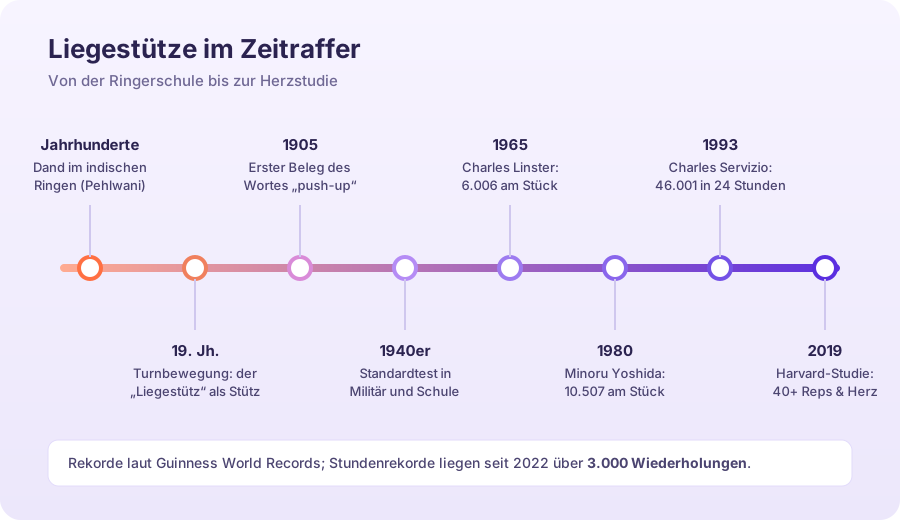
The roots: a movement without a name
India: dand and the wrestling school
The oldest well-documented forerunners come from Indian wrestling, pehlwani, and its predecessor forms. In the traditional training grounds, the akharas, two exercises have belonged to the daily routine for centuries: the baithak, a deep squat, and the dand — a wave-like push-up variation in which the body dives forward and up out of a high-hip position in a circular motion. In the West, the dand is known today as the "Hindu push-up." It trains not just chest and arms but mobilizes the entire spine and shoulder — which explains why it never went out of fashion in wrestling, where mobility under load is everything.
The numbers attributed to the great wrestlers of the early 20th century are legendary: the Great Gama, considered unbeatable between 1900 and 1920, is said to have performed thousands of dands and baithaks daily. How much of that is legend and how much training log can no longer be settled — that the dand is the backbone of one of the oldest documented bodyweight training systems in the world can.
Antiquity and martial arts: more speculation than evidence
You often read that Roman legionaries or Greek athletes already trained push-ups. There is no direct evidence for this. Ancient gymnastics knew support positions and floor exercises, but the surviving sources describe no standardized push-up movement. It's similar in Chinese martial arts, where supporting exercises on fists and fingers have long been part of conditioning — without a date or an inventor that can be named. The movement is old; the exercise as we know it is not.
The 19th century: from "support" to push-up
The German word for push-up, "Liegestütz," owes its existence to the gymnastics movement. When Friedrich Ludwig Jahn opened the first gymnastics field on Berlin's Hasenheide in 1811, gymnastics brought its own vocabulary with it: hang, support, swing, turn. In gymnastics, a "support" is any position in which the arms carry the body — on the parallel bars, on the horizontal bar, on the floor. A "Liegestütz" was therefore initially a position: lying stretched out, supported on the hands. Only over time did it become the movement we count today.
In parallel, in Sweden, Pehr Henrik Ling was shaping his "Swedish gymnastics," a system of standardized free exercises without equipment that spread through schools and armies across Europe. Both traditions — German gymnastics and Swedish gymnastics — brought floor exercises into the curricula of schools and the military. The push-up became a school exercise, and school exercises get counted. This is exactly where its career as a test procedure begins.
1905: the word "push-up"
According to Merriam-Webster, the word push-up first appears in English in 1905; the British variant press-up follows shortly after. The timing is no coincidence. Around the turn of the century, the Western world experienced its first fitness wave: the "physical culture" movement around figures like Eugen Sandow and Bernarr Macfadden sold courses, magazines, and training systems to a mass audience — and bodyweight exercises were the ideal product, because anyone could do them at home. The push-up got a name because it had become a market.
Military and school: the exercise becomes a test
The 20th century turned the push-up into a metric. Armies need a fitness test that works without equipment, anywhere, for thousands of recruits at once — and hardly any exercise fits that bill as well. From the 1940s onward, push-ups were a fixed part of US armed forces aptitude and fitness tests. Their best-known format was the Army Physical Fitness Test (APFT), which ran from 1980 into the early 2020s: two minutes of push-ups, two minutes of sit-ups, a two-mile run. Its successor, the Army Combat Fitness Test, replaced the classic variant with the "hand-release push-up," in which the hands briefly leave the floor at the lowest point — an attempt to make half-reps impossible.
From the army, the test spread into police and firefighter selection processes, into school fitness tests, and into the norm tables of sports medicine. The American College of Sports Medicine still maintains reference values for maximum push-up count by age and gender today — the same kind of test the firefighters in the later famous Harvard study performed.
The chase for records
As soon as something gets counted, someone wants the biggest number. The push-up records of the 20th century read like an escalation:
| Year | Who | What | Number |
|---|---|---|---|
| 1965 | Charles Linster (USA) | Push-ups in a row | 6,006 |
| 1980 | Minoru Yoshida (Japan) | Push-ups in a row | 10,507 |
| 1988–1989 | Paddy Doyle (GB) | Push-ups in one year | 1,500,230 |
| 1993 | Charles Servizio (USA) | Push-ups in 24 hours | 46,001 |
| since 2022 | several athletes | Push-ups in one hour | over 3,000 |
Minoru Yoshida's mark of 10,507 unbroken reps from October 1980 stands to this day and will likely remain unbroken — hardly anyone still attempts the "unbroken" category. Charles Servizio needed around 21 hours for his 46,001 push-ups in 1993 — an average of more than 36 reps per minute over almost an entire day. And the hour records of the 2020s, in which Australians most recently topped the 3,000-rep mark, correspond to more than 50 push-ups per minute, for sixty minutes straight.
What these numbers show is less the limit of the musculature than that of the will — and a detail every trainee knows: at such volumes, the rep is no longer deep and controlled, but as minimal as the rules allow. That's exactly why record rules define depth and extension down to the centimeter.
Science discovers the push-up
For a long time, the push-up was a training and test exercise but not a research subject. That changed in the 2000s, as electromyography and force plates made their way into sports-science labs. Studies such as Cogley et al. (2005) on hand position or Ebben et al. (2011) on moved bodyweight measured the exercise precisely for the first time — we've summarized the results in the article Which Muscles Do Push-Ups Train?
But the exercise made its biggest leap into public awareness in 2019, when a team from the Harvard T.H. Chan School of Public Health showed in the journal JAMA Network Open that men who could do more than 40 push-ups in a row had a drastically lower risk of cardiovascular events over the following ten years than those who managed fewer than ten. The study was cited worldwide, often simplified, sometimes misunderstood — what it really shows and what it doesn't is covered in our analysis of the Harvard study. For the history of the exercise, it's a turning point: the push-up was no longer just a fitness test, but a marker of health.
Pop culture and the return of bodyweight training
The fitness industry had nearly forgotten the push-up in the 1980s and 1990s — machines, dumbbells, and aerobics studios were the business. It came back through the internet. In 2008, "One Hundred Push-ups," a six-week program from beginner test to 100 reps in a row, made the rounds as one of the first viral fitness challenges. Shortly after, the street workout and calisthenics scene grew out of parks in New York and Eastern Europe, establishing bodyweight training as its own discipline with competitions. And when studios closed worldwide in 2020, suddenly the oldest exercise in the world found itself back at the center: push-up challenges on social media, tracking apps, daily streaks. The push-up was once again what it had been in 1811 on the Hasenheide — an exercise for everyone, everywhere, no equipment needed.
Why this exercise survived
Trends in the fitness world rarely last longer than a decade. The push-up has been documented for two centuries and presumably in use for millennia. Three properties explain why:
- It needs nothing. No equipment, no gym, no cost. Every barracks, every school, every living room is a training ground.
- It's scalable. From the wall push-up to the one-arm push-up, the same movement covers a strength spectrum that would otherwise require an entire set of dumbbells — see our guide to variations for the full overview.
- It's countable. A rep is a rep. That's what turned it into a test, a record, a study — and a challenge.
Conclusion
The history of the push-up is the history of a movement that was always there, and an exercise that only began once someone started counting: in the akharas of India, on the gymnastics fields of Berlin, in the barracks of the 20th century, and in the labs of the 21st. Everyone who logs their reps this morning is writing a small piece of it forward.